Suicide Prevention 1: Community Education
Suicide Prevention 1: Community Education
This course is designed for community leaders and individuals who directly engage with Asian* populations, particularly those who may be at heightened risk of experiencing suicidal thoughts or behaviors. Participants will explore cultural perspectives on mental health, recognise suicide warning signs, and learn culturally relevant support strategies. The course also covers how health issues manifest differently in Asian communities and enhances awareness of mental health resilience in the New Zealand context.
- Who the course is for
- Community leaders and individuals who directly engage with Asian* populations
- Duration
- 2-2.5 hours
Course overview
This course is organised into three main units, with an introduction and conclusion. Each unit builds practical knowledge and culturally responsive skills to help community leaders recognise distress, respond safely, and support pathways to professional help within Asian communities.
Learning outcomes
By the end of this course, you will be able to:
- Reflect on your own cultural perspectives and how they may shape your approach to supporting others.
- Recognise how cultural beliefs, family expectations, and stigma influence mental health and help-seeking in Asian communities.
- Understand how social, cultural, and health factors impact mental well-being and resilience in New Zealand’s Asian communities.
- Identify common warning signs of suicide and distress that may present differently across cultures.
- Clarify your role as a community leader in suicide prevention and know when and how to connect individuals to professional support.
- Use culturally appropriate strategies to support individuals in distress and help them access professional mental health resources.
- Communicate with cultural sensitivity, building trust while encouraging individuals to seek the help they need.
Pre-requisites
While there are no prerequisites for this course, we do highly recommend these other training resources:
Course outline
This course is organised into three main units, with an introductory and concluding section. Each lesson builds practical knowledge and skills for supporting mental wellbeing in your community with cultural awareness and confidence.
Introduction
- 0.1
Course Welcome & Overview
Get oriented with the course goals, structure, and key learning areas. - 0.2
Cultural Context
A brief introduction to cultural values and beliefs that may shape mental health experiences in Asian communities. - 0.3
Case Study Profiles
Explore real-life inspired case studies that bring these cultural contexts to life. - 0.4
Acknowledging Personal Biases
Reflect on your own assumptions and how they may impact the support you offer.
Unit 1 | Understanding Cultural Influences on Mental Health
- 1.1
How Cultural Values and Stigma Influence Mental Health
Understand how cultural beliefs, stigma, and emotional expression affect mental wellbeing and help-seeking. - 1.2
Societal Barriers to Seeking Help
Identify systemic and institutional challenges that impact access to mental health services for Asian communities. - 1.3
Recognising Signs of Distress – When Feelings Show Up Differently
Identify how distress can be expressed differently depending on cultural norms. - 1.4
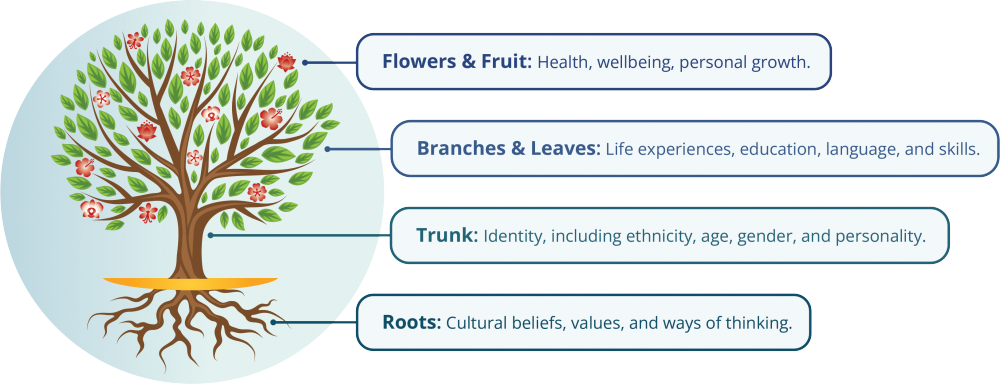
The Integrated Tree Model©: A Holistic Way to Support Well-Being
Learn to apply a culturally grounded framework to assess well-being across layered aspects of a person’s identity and experience.
Unit 2 | Recognising & Responding to Suicidal Behaviours
- 2.1
Identifying Risk, Protective Factors & Subtle Warning Signs
Recognise early signs of distress and understand what helps or hinders wellbeing in your community. - 2.2
Building Trust & Overcoming Barriers
Learn ways to communicate effectively and build trust across cultural contexts. - 2.3
Responding to Distress with Cultural Sensitivity
Explore practical strategies for responding to distress situations with cultural respect and confidence. - 2.4
Putting Your Skills into Practice
Apply what you’ve learned through real-life case studies and scenarios.
Unit 3 | Bridging to Professional Support & Resources
- 3.1
Defining the Role of a Community Leader
Clarify your role and responsibilities in supporting others and knowing your limits. - 3.2
Recognising Support Needs and Referral Pathways
Understand how to identify when someone needs more help and how to refer them to professional services. - 3.3
Connecting Individuals with Professional Services
Address barriers and learn techniques to help others feel safe and supported in accessing mental health care. - 3.4
Supporting Individuals in Distress & Facilitating Referrals
Demonstrate your understanding through a final scenario-based assessment.
Conclusion
- 4.1
Recap of Key Learnings
Review the core ideas and strategies covered throughout the course. - 4.2
Personal Growth & Next Steps
Reflect on how the course has shaped your approach and how you’ll use your learning in practice. - 4.3
Self-Care Toolkit
Discover simple ways to care for your own wellbeing while supporting others. - 4.4
Course Certificate & Additional Resources
Download your course completion certificate and access key takeaways, suggested next steps for professional development, and contacts for support services.